Skip to content
RevSeekr

Pricing transformation for complex B2B

Most pricing platforms stall on the extract.

Cost that is six weeks old. Customer IDs that do not match. Hierarchies nobody owns. We assess whether the data can hold the rules — then implement Pricefx when it can.

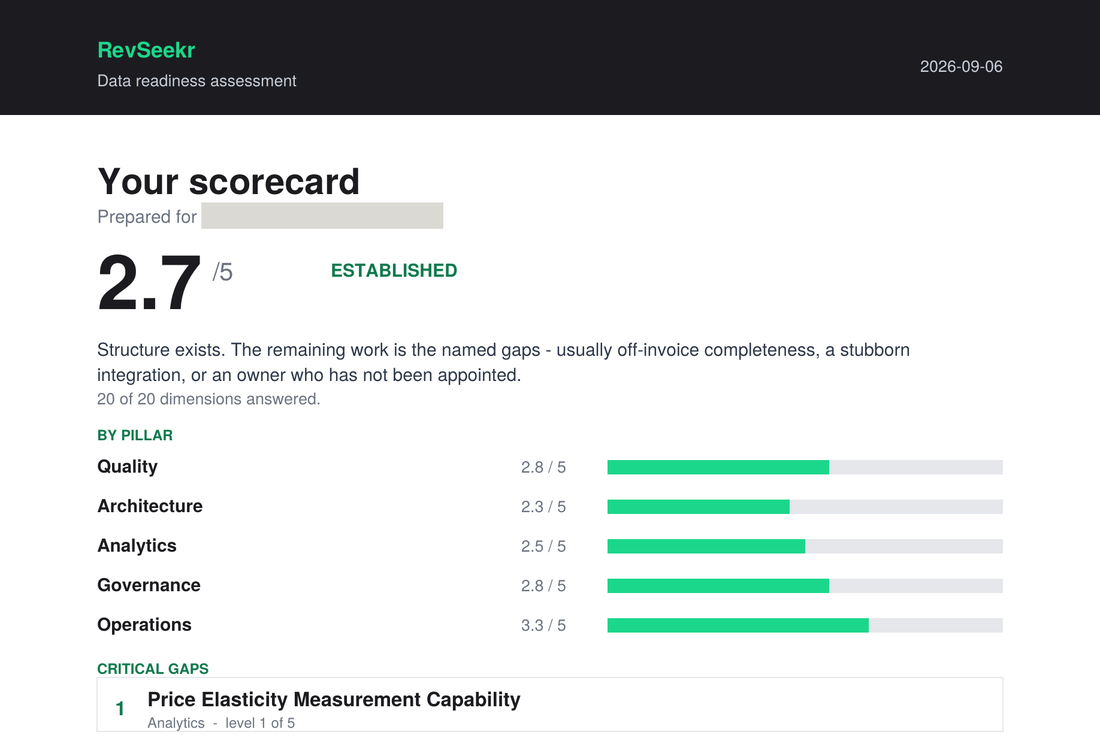
First page of an emailed Data Readiness report: overall score 2.7 out of 5, band Established, five pillar bars from 2.3 to 3.3, and the top-ranked gap, price elasticity measurement.
Illustrative report page. Your answers are used to produce your report and nothing else — how we handle data.

Start where you are

  1. Before the commitment

    Make a defensible investment decision.

    Evaluating pricing technology, building the business case, or asking whether the data, process and organization are ready.

    Find the right diagnostic →
  2. During delivery

    Turn pricing decisions into a working Pricefx platform.

    The program is approved. Commercial decisions must become configuration, integrations, testing, training and a controlled launch.

    What implementation covers →
  3. After go-live

    Stabilize what is live and extend its value.

    The platform is live, but adoption, data, support or outdated rules are limiting what it returns.

    Phase 5, Evolve →

Self-serve · 12 minutes · no login

Data Readiness Assessment

Twenty dimensions across quality, architecture, analytics, governance and operations — the test of whether the extract can hold the rules you want to run.

What you leave withA maturity score by pillar, your ranked gaps, and a next-rung roadmap. Print-ready, in your inbox.

Start the assessment

The real blocker

The algorithm is not the first problem.

Vendors promise margin gains through machine learning and dynamic pricing. They're right — after the extract can hold the rules, and after sales will use what comes back. Data is the one we measure first.

Data first

Pricing programs stall when cost, deal and customer data cannot support the rules the platform is asked to run — not when the algorithm is wrong.

Adoption

Sales will not trust a recommendation it did not help design. Without authority, incentives and training, expensive software becomes shelfware.

Order of work

Foundation before configuration shortens time to value. Buying the tool first and discovering readiness later is how timelines double.

Sometimes Discover ends with a recommendation not to buy software yet. That conversation is why clients come back.

Selected engagement · food production · multi-country

From 30+ price lists to one pricing matrix.

An anonymized food producer moved from fragmented, locally maintained pricing to a common structure with explicit decisions, guardrails and rollout governance. The technology was the straightforward part; requirements governance set the timeline.

Read the engagement, including what we would do differently →

One engagement, not a benchmark. How we talk about results →

Starting point
More than thirty spreadsheet price lists, different update cadences and no single view of the price waterfall.
Work
Map the process that actually ran, challenge local exceptions, formalize decision rights and configure a phased rollout.
Result
One pricing matrix, defined approval paths, configured guardrails and a shared source for pricing analytics.

The method

Five phases, in this order, every time.

The full method, phase by phase →
  1. 01Discover
  2. 02Design
  3. 03Build
  4. 04Launch
  5. 05Evolve

The sequence is how failed pricing projects get avoided: readiness is established across data, process and decision rights before anyone configures software.

The conversation

Thirty minutes with the person who would run Discover.

Not a qualification call. You talk to the person who would scope and run the first phase, and leave with a clear next step — or a clear reason to wait.

What we will cover

  1. Where the program stands today: the data, the operating model and the people who will have to use what comes back.
  2. Which diagnostic fits your situation, or whether the answer is already clear without one.
  3. What a Readiness & Roadmap engagement would cover, who it needs from your side, and how it is commissioned.

You'll meet Luis or Nicolás. English or Spanish. No deck.