
When SAP and Salesforce Both Price the Deal, Who's Actually in Control?
Both vendors have a credible claim on the price. Most enterprises have never told either one which answer they are buying.
A composite field note, not one organization. How we talk about results →
A rep quotes a customer in Salesforce CPQ. The customer signs. The order flows into SAP. SAP reprices it. Nobody catches the gap until month-end reconciliation, when finance notices that the invoiced amount doesn’t match the signed quote on 7% of the line items.
That scenario shows up in some form at almost every enterprise running both systems, and most companies have stopped being surprised by it. The usual response is a monthly reconciliation workstream, a few tribal rules about which system wins when, and a lot of hours lost to cleanup.
Here’s the thing most organizations won’t say out loud: they don’t actually have a pricing architecture. They have a set of overlapping decisions that happen to produce a number.
The harder conversation is what to do about that. Both SAP and Salesforce have been quietly expanding their claim on the price. Your pricing strategy is being shaped by that turf war whether or not anyone has explicitly picked a side.
The question isn’t which platform is better at pricing. It’s which part of the price each platform is supposed to own, and whether your current setup actually reflects that decision or is accidentally defaulting to whichever system the user happens to be in.
The Two Gravitational Pulls
For a long time the answer was simple. SAP handled master pricing, condition records, rebates, invoicing. Salesforce handled the sales motion, the quote, maybe some basic discounting. The ERP was the source of truth, the CRM was the front door.
That clean split has mostly eroded.
On the Salesforce side, CPQ (now Revenue Cloud / Revenue Lifecycle Management) has grown into a full quote-to-cash platform. It holds product catalogs, price rules, discount approval workflows, contract pricing, subscription billing logic. Salesforce isn’t positioning Revenue Cloud as a front end to your ERP anymore. They’re positioning it as the revenue system of record, with the ERP handling financial posting at the end.
On the SAP side, S/4HANA’s pricing engine has the same ambition in reverse. Clean Core, Business Data Cloud, Joule sitting on top, and an explicit pitch that your pricing intelligence belongs inside the ERP, not bolted onto a CRM that wasn’t designed for condition technique complexity.
Both vendors have a credible claim. Both have a roadmap that assumes they win. Most enterprises haven’t told either one which answer they’re buying.
Where the Price Actually Diverges
The mismatch shows up in three recurring places.
The discount
Salesforce CPQ approves a 12% deal discount. SAP’s pricing procedure calculates net price differently, maybe because there’s a condition type in SAP that Salesforce doesn’t know about, maybe because a rebate accrual kicks in at the invoice step. The signed price and the invoiced price don’t match, and it’s hard to say which one was actually wrong.
Master data
Customer A in Salesforce is the same as Customer A in SAP, except their tier updated last Tuesday in SAP and the nightly sync hasn’t run yet. A rep quotes off yesterday’s tier. By the time the order hits SAP, the tier has already moved.
The exception
A strategic account negotiates a one-off arrangement. Sales captures it in a Salesforce opportunity. Someone in pricing ops writes a custom condition record in SAP. A year later nobody can reconstruct whether the contract pricing matches what’s being invoiced, because the source of truth lives in two systems and a shared OneDrive folder.
The cost isn’t just reconciliation effort. Customers notice when the quote price changes at invoicing. That stops being an integration story the second it reaches them. It becomes a credibility story, and it’s the kind you pay for on the next renewal, in the next RFP, and in the reference call nobody tells you happened. Two different prices for the same customer erode trust in the system, in the sales team, and eventually in the brand.
The Agentforce and Joule Problem
This is where the coordination cost compounds.
Salesforce is pushing Agentforce broadly across Revenue Cloud. An Agentforce agent can draft a quote, suggest a discount, identify deal risk, recommend contract terms. It’s reading from Salesforce’s view of the customer, the price book, and the approval rules.
SAP is shipping the equivalent with Joule. Joule can explain a pricing decision inside a sales order, flag margin risk on a quote, surface a rebate eligibility. It’s reading from SAP’s view of the customer, the condition records, and the pricing procedure.
Neither agent knows what the other one recommended five minutes ago.
That isn’t a data problem. It’s a governance one. You now have two reasoning systems making price recommendations on the same customer, on the same day, with different data, different rules, and no shared context. Without a layer that tells them which decisions are whose to make, you don’t just have system conflicts. You have competing decision makers, and whichever one a salesperson happened to ask last is the one that wins.
There’s a trust cost that almost nobody is pricing in. Sales teams that catch two agents disagreeing on the same customer will stop trusting either agent within a quarter. That’s the one kind of trust enterprises can’t afford to lose this early in the AI adoption cycle, because it doesn’t come back quickly.
The Pricing Authority Stack
When you look at a revenue stack that has SAP, Salesforce, a pricing platform, and now autonomous agents on top of all of it, the useful way to think about pricing is in three layers, not two.
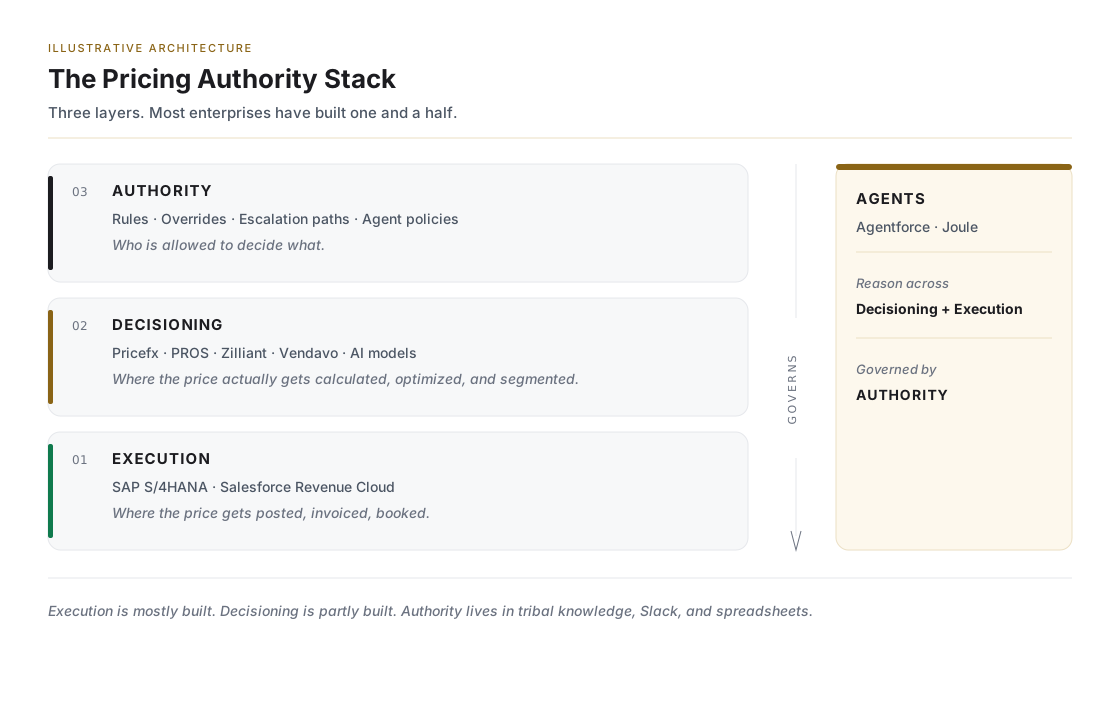
Execution. SAP S/4HANA and Salesforce Revenue Cloud. This is where the price gets posted, invoiced, booked, reported. It’s transactional infrastructure.
Decisioning. A dedicated pricing platform (Pricefx, PROS, Zilliant, Vendavo) or the AI models that sit on top of it. This is where the price actually gets calculated, optimized, and segmented. It’s where the intelligence lives.
Authority. The rules, overrides, escalation paths, and agent policies that govern who is allowed to decide what. This is the layer almost nobody has built. It’s also the layer that determines whether your AI investments produce consistent answers or drift into chaos.
Today, authority mostly lives in tribal knowledge, Slack threads, and spreadsheets, plus the three or four senior pricing people who don’t have time to write it all down. That was a tolerable gap when a human approved every exception. It stops being tolerable the moment agents are recommending exceptions on your behalf.
What the Authority layer looks like in practice
- A policy that Agentforce-suggested discounts under 8% auto-commit, 8–15% require a human click, and anything above 15% requires both a human approval and a Joule margin check.
- A rule that a Joule margin flag above 3% is always blocking, not advisory, even if Agentforce has already recommended the price on the Salesforce side.
- A rule that when Agentforce and Joule disagree on the same customer within a 24-hour window, the system defaults to the more conservative number and logs the conflict for the pricing manager to review by end of day.
- A rule that agent-committed prices on strategic accounts (top 50 by revenue) require a human confirmation regardless of agent confidence score.
None of that is exotic. It’s the kind of logic pricing leaders carry in their heads today. Writing it down, in a place where both agents and both platforms have to respect it, is the Authority layer.
My working view. For most complex B2B enterprises, once pricing sophistication is mapped honestly, pricing intelligence belongs in a dedicated decisioning layer that governs both SAP and Salesforce, with an explicit authority layer on top of it. There are real exceptions. Companies with heavy intercompany pricing, deep condition technique logic, or regulated pricing in manufacturing or process industries often find SAP is still the right master, because that’s where the complexity already lives. Subscription-heavy businesses with fast-cycle negotiated quoting and contract lifecycle at the core often find Salesforce Revenue Cloud is the real answer. The dedicated layer fits the broad middle, which is a bigger slice of B2B than most teams want to admit, but not all of it. The point isn’t that one answer wins. It’s that the answer has to be picked on purpose.
What Has to Be Decided Explicitly
There isn’t a universal right answer on day one. There is a set of decisions that have to be made on purpose rather than drift into a default.
Which system holds the master of pricing intelligence. If your pricing sophistication lives in optimization, segmentation, deal scoring, AI guidance, that belongs in a dedicated decisioning layer that writes clean output into both SAP and Salesforce. If your pricing is mostly transactional, it stays in SAP. If your pricing lives primarily in negotiated quotes and approvals, Salesforce Revenue Cloud has a real case.
Which system holds the master of customer and product data. Agents can’t reason about pricing if the entities they’re pricing don’t reconcile. Master Data Management was a boring conversation ten years ago. It’s now the foundation that determines whether your AI investments produce consistent answers.
What the handoff protocol is. When does Salesforce stop writing to the quote and SAP start owning it. What happens if the customer changes a line after booking. Where does a rebate accrual get calculated. These aren’t questions the vendors will answer for you.
What an agent is allowed to commit to. Agentforce can draft a price. Can it commit one. If Joule flags a margin risk, is it advisory or blocking. This is the authority layer showing up as a governance question, and “we’ll figure it out as we go” is how you end up with inconsistent AI behavior across the sales team within a quarter.
Four Questions to Bring to Your Next Architecture Review
- If a rep quotes a price in Salesforce CPQ and SAP calculates a different price on the order, which one is correct, and how do we know in practice (today, not in theory)?
- When master data changes in SAP (customer tier, product catalog, condition record), how long is the delay before Salesforce sees it, and how many quotes get written against stale data in that window?
- Have we explicitly picked whether Salesforce Revenue Cloud, SAP S/4HANA, or a dedicated decisioning layer is the master of pricing intelligence, or is the answer defaulting to whichever platform a user happens to be in?
- When Agentforce and Joule are both reasoning about the same customer, what rules decide which agent’s recommendation takes precedence, and who is accountable if they disagree?
If the answer to any of these is unclear, that’s the authority gap. Close it before either vendor’s next AI release stacks another layer of autonomous decision-making on top of it.
The Takeaway
Running SAP and Salesforce in the same revenue stack was always a coordination problem. Pricing sat at the center of it, and most organizations managed the gap with reconciliation work and tribal knowledge.
That approach worked when both systems were transactional. It stops working when both systems start reasoning. The architectural question you’ve been able to defer for a decade (who owns the price) is about to stop being optional.
Defining the authority layer is the work. Operating it (governance, adoption, continuous optimization) is the harder, longer work, and it’s the part that actually determines whether your pricing architecture produces results or just a cleaner diagram.
The companies that build this layer deliberately will compound an advantage. The ones that don’t will scale inconsistency faster with AI, which is the worst outcome on both sides of the ledger. The vendors aren’t going to resolve this for you. Each roadmap assumes they win. The decision is yours to make on purpose.
Sources
Product capabilities described reflect vendor announcements and published documentation as of April 2026. Vendor references reflect independent editorial perspective. Disclosure: RevSeekr implements Pricefx commercially and holds no partnership, certification or endorsement from any vendor named here. Scenarios are composites drawn from client work, not descriptions of any single organization. Company and product names are trademarks of their respective owners.