
Salesforce Just Went Headless. Your Pricing Approvals Didn't.
The manager opening the quote page and pattern-matching against past deals was the governance. Nobody called it that, but that is what it was.
Headless 360 turned the CRM into infrastructure for agents. Almost nobody is asking the right question: what happens to every pricing approval workflow that silently assumed a human would look at a screen.
Last week at TDX, Parker Harris asked the question that tells you where Salesforce is going:
“Why should you ever log into Salesforce again?”
Headless 360 is that question turned into a product. Every capability in the Salesforce platform is now callable without a browser, through APIs, MCP tools, and CLI commands. Agentforce Vibes 2.0 ships an IDE built around it. A new Experience Layer renders Salesforce output inside Slack, Teams, ChatGPT, and Claude.
For most of the business, this is a straight productivity win. Agents that can read data, compose outputs, and act without context switching will save real hours across sales, service, and operations. The concern below is narrower.
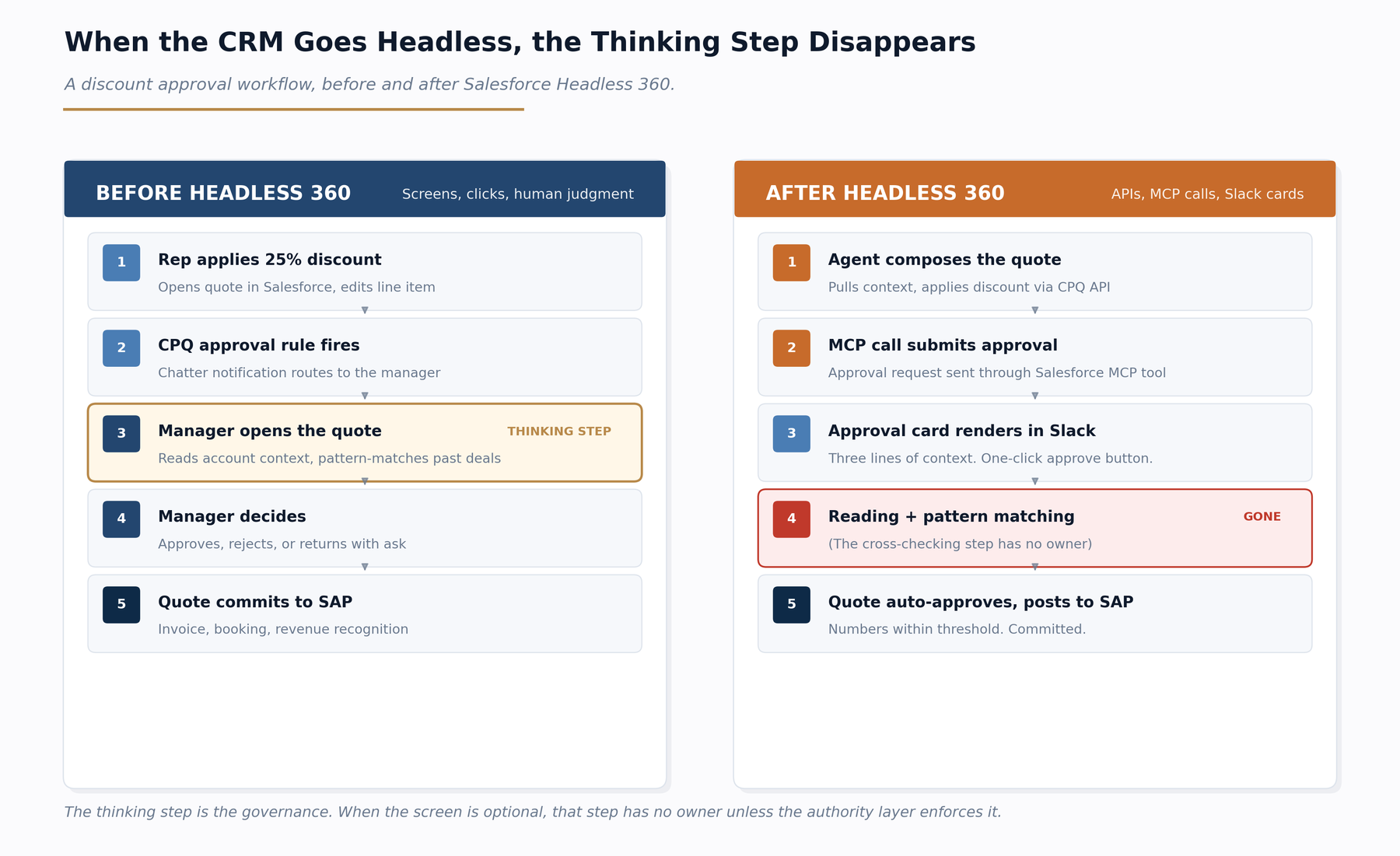
Pricing sits in one of the places where the cognitive work people did on a screen was the actual control. The CPQ approval rule triggered, a Chatter notification hit a manager, the manager opened the quote page, pattern-matched against past deals, and clicked approve. That click was the governance. Nobody called it that, but that is what it was.
Remove the screen from the loop and much of the control built on it comes with it.
What actually shipped, briefly
Most readers will already know the announcement. The short version: every Salesforce capability is now an API, an MCP tool (Model Context Protocol, the standard that lets coding agents call enterprise functions), or a CLI command. Sixty-plus new MCP tools. An Experience Layer that renders native UI inside Slack, Teams, and the major chat agents. Agent Fabric, an orchestration layer for multi-agent workflows. Agentforce Vibes 2.0, the IDE for building on all of it. The intent line, in Benioff’s framing: the Salesforce platform is now “infrastructure for AI agents.”
What last week said, and what Headless 360 confirmed
For readers who missed the previous piece, the frame was that most enterprises have built two of three pricing layers. Execution is where prices are posted and invoiced, usually SAP or Salesforce. Decisioning is where prices are actually calculated, usually Pricefx, PROS, Zilliant, Vendavo, or AI models. Authority is who is allowed to decide what. Authority almost never exists as a real system. It lives in tribal knowledge, Slack, and spreadsheets.
Authority used to be a quiet problem because pricing was a human decision. A rep asked. A manager approved. An auditor could reconstruct the chain from emails and Salesforce approval history.
Headless 360 is the news event that moves the timeline. The moment an agent can read customer context, compose a price, write a quote, and push to SAP without a human click, authority stops being an architectural preference. It becomes the thing a controller will ask about at the next audit.
Five pricing workflows that weaken when the CRM goes headless
Here are the patterns I see most often at clients, and where each one loses its edge.
1. The CPQ discount approval chain
Rep applies 25 percent. An approval rule fires. A manager gets notified, opens the quote record, sees the context, and decides. At 40 percent the chain adds finance. At 50 percent, the CRO.
The pattern assumes a human opens a Salesforce page and reads it. Under Headless 360, an agent can call the CPQ API, generate a quote, apply a discount, and route approval through the same chain, except the approver may be another agent, or the request may surface as an Experience Layer card in Slack with three lines of context and a one-click approve. The cross-checking, the gut check, the pattern match against last quarter’s deals, none of that is in the API contract. It was in the operator.
2. The deal desk review
Non-standard deals route to deal desk. Deal desk pulls the quote, the account history, the margin profile, and the strategic context. That review is expensive and slow because it is a thinking step, not a routing step.
When the CRM is a set of APIs, an agent can assemble the same inputs in under a second, plus a recommendation that sounds authoritative. If deal desk starts triaging agent-recommended decisions, the queue speeds up and the quality of thinking inside each review goes down unless you have explicit rules about which decisions an agent is even allowed to ask for.
3. Validation rules as the last line of defense
Most pricing governance in Salesforce runs through validation rules, Process Builder, Flow, and approval processes. They are the backstop.
TDX 2026 press coverage flagged the gap explicitly: Salesforce shipped the agent infrastructure without a story for how validation rules, Process Builder, Flow, and approvals behave when agents are the primary caller. Agents do not read error messages the way humans do. A rule that tells a rep “this discount exceeds your tier” gets a human retry. The same rule hit by an agent can loop, rephrase, try a different path, or simply log and move on. Your guardrails were designed for a class of caller that no longer dominates.
4. Manager override and the override log
When a price is outside policy, a manager overrides and types a justification. “Strategic account.” “Quarter-end give.” “Matching competitor X.” That text field is the audit trail and the management coaching record. Finance reads it at close. Sales leadership reads it for patterns.
Agents can populate the same field, convincingly. A half-human, half-agent override log that reads uniformly well is not an audit trail anymore. It is narrative.
5. The “get it in writing” pattern
Outside the formal workflow, most pricing policy lives in a Slack channel, an email thread, a quarterly pricing memo, or a spreadsheet. Rep wants a deal, someone asks deal desk, someone else asks the CRO, an answer comes back in writing, everyone moves on.
That informal layer is the real authority layer at most companies. It works because the people involved know the unwritten rules. Once agents can read those policy documents and commit quotes through MCP, the informal layer becomes machine-readable and, just as easily, machine-abusable. Any policy documented only in a Slack thread is now a policy an agent can quote back at you.
The gap Salesforce shipped around, not through
The most honest read I have seen of Headless 360 came from the Salesforce DevOps community at TDX. The observation was blunt: the announcement widens the builder gap. Pro-code developers got a platform. Admins who built and maintained the approval, validation, and flow ecosystem for twenty years did not get a bridge program.
Translated into pricing terms, that gap is the authority layer. Salesforce shipped infrastructure for agents to act. It did not ship a model for how policy and exception handling carry over from the UI era. Agent Fabric will help orchestrate multi-agent workflows, and it matters, but it is plumbing, not a pricing authority product. The authority layer for pricing is yours to build. Headless 360 just made it urgent.
The working view, sharpened
My view has not changed since last week, but the timeline did. Pricing decisioning belongs in a dedicated decisioning layer, with an explicit authority layer on top that governs SAP, Salesforce, and the agents talking to both.
This is also why the companies that have already separated pricing decisioning from their CRM and ERP are in the strongest position right now. They have a place to put the authority layer. Everyone else is now choosing between building one under pressure or watching agents make pricing decisions inside systems that were never designed to govern them.
What good looks like
A modern pricing authority layer has three things at minimum. Agent-aware policy rules that do not depend on UI-based enforcement. Immutable audit trails that distinguish human decisions from machine decisions. Real-time decisioning that both humans and agents are required to call before a price commits anywhere. Build those three, and the velocity upside of Headless 360 turns into an advantage rather than a governance gap.
Four questions for your next architecture review
1. Which of our pricing approval workflows assume a human opens a screen?
Make a list. Discount approvals, deal desk queues, exception logging, override justifications. For each one, write down what the control actually is. If the control is “a person notices something looks off,” you have a headless problem waiting to happen.
2. If an agent calls our CPQ API tomorrow, what rule stops it from committing an unauthorized price?
Not a validation rule. A policy rule. Something that encodes intent, not just syntax. If the answer is “the manager would see it,” ask whether the manager will still see it when the quote is composed by an agent and submitted through MCP.
3. Where does our authority layer actually live, and can it be enforced against a non-human caller?
Name the system. If the honest answer is “Slack, email, a pricing memo from 2023, and tribal knowledge,” you do not have an authority layer. You have an authority pattern inside human operators. That is not portable to agents.
4. What does the audit trail look like when an agent makes a pricing decision, and is it good enough for a controller?
Run the scenario. Agent composes a quote, applies a discount, submits for approval, gets auto-approved because numbers are under threshold, posts to SAP. At year-end, the controller asks why that discount was given. What do you show? If the answer depends on agent-written justification text, you have a narrative problem posing as an audit trail.
A final note
Headless 360 is a well-built product and an honest signal about where enterprise software is going. The problem is not the product. The problem is that the pricing conversation has been busy arguing over which system should own pricing intelligence, SAP or Salesforce, while both vendors quietly moved the game a layer up.
The layer that matters now is authority. The sooner pricing leaders stop treating it as an architectural preference and start treating it as a control, the cleaner the agent era looks for the P&L.
Key takeaways
- Salesforce is now agent infrastructure. Headless 360 exposes every platform capability as an API, MCP tool, or CLI command. The browser is optional.
- The UI was the pricing control. Most approval workflows quietly assume a human opens a screen. When the screen is optional, the control built into that reading step goes with it.
- Your guardrails were designed for human callers. Validation rules, approval chains, and override logs behave differently when an agent is the one hitting them.
- Salesforce shipped the infrastructure, not the governance bridge. The industry press flagged the gap at TDX. The authority layer for pricing is yours to build.
- Separation pays off. Companies that already moved pricing decisioning out of SAP and Salesforce have the cleanest place to put an authority layer over the agents.
- The timeline moved. Waiting for a 2027 agent-governance conversation means inheriting it as an audit finding.
Sources
Originally published by RevSeekr on LinkedIn on April 23, 2026. Product capabilities reflect Salesforce announcements at TDX 2026 (April 2026) and contemporaneous press and developer-community coverage. Workflow examples are composites drawn from client patterns, not descriptions of any single organization. Company and product names are trademarks of their respective owners.